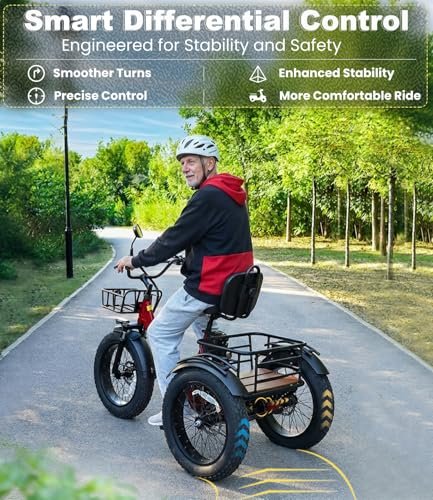
The Z139's rear differential lets each rear wheel rotate independently — the same principle every four-wheeled vehicle uses — so corners feel controlled instead of forced.
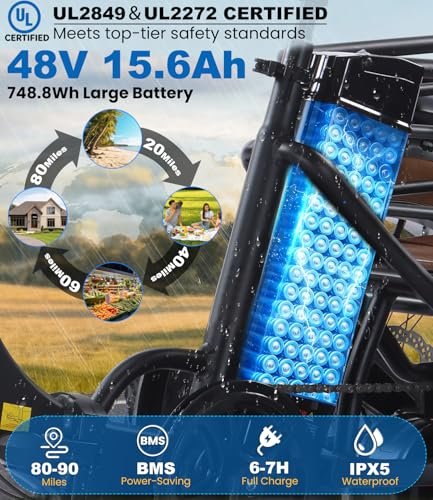
The 48V 15.6Ah removable battery carries UL2272 certification — the standard fire codes and many HOA storage rules name specifically — with IPX5 waterproof protection and onboard BMS.
The step-through frame folds to fit a sedan trunk or standard apartment elevator — practical storage for riders who don't have a dedicated garage or bike room.
The Z139 arrives nearly ready to ride, with a 1-year electronics warranty, 2-year frame warranty, lifetime technical support, and 24/7 access to US-based customer service.
Every Z139 variant shares the same motor, differential, battery, braking system, and frame — the choice between them comes down to colorway and whether you want a phone holder and cup holder included out of the box. Check current availability and pricing on Amazon, where all colors ship the same way: trike in one box, charger and accessories in a second.
The primary Z139 listing in Orange Teal — 750W rated motor peaking at 1,350W with 115 Nm torque, rear differential, UL2272-certified 748.8 Wh battery, and front and rear cargo baskets on a reinforced rear rack rated to 440 lbs total. Rated for riders up to 330 lbs.
The flagship listing with the most complete spec documentation — best for solo riders who want the full Z139 feature set and the widest color selection.
See on Amazon
Mechanically identical to the Orange Teal Z139 — same 750W rated motor, 748.8 Wh battery, differential, and braking system — in a Brown and Black colorway. This variant ships with a phone holder and cup holder included as standard accessories.
The right pick if you prefer the Brown and Black colorway or want the phone and cup holders without sourcing them separately.
See on AmazonDiscover the full product lineup with current selection on Amazon.
All products on AmazonThe Z139 isn't for everyone, and that's the point. It's built for riders who've made a deliberate decision about stability — not riders who couldn't figure out a two-wheeler. There's a meaningful difference, and the engineering reflects it.
This is the largest group buying the Z139, and the trike addresses their actual situation honestly. People managing vertigo, post-stroke mobility challenges, MS-related balance issues, or a recent hip or knee surgery aren't looking for a "senior-friendly" product — they're looking for a machine that won't fall over when they stop. Three wheels do that. The step-through frame means no leg-swing over a crossbar, which matters enormously if hip flexion is limited. The wide adjustable seat and curved backrest distribute pressure across a longer ride, not just for the first 10 minutes.
One honest caveat: the Z139 weighs 115 lbs. If you're managing a condition that affects upper-body strength, you'll want a helper for loading it into a vehicle. The trike is stable in motion — getting it in and out of a truck bed is the harder part.
The second group is adults replacing short car trips — grocery runs, pharmacy visits, neighborhood errands — who live in apartments, condos, or townhouses without dedicated bike storage. The Z139's folding frame is why this works. It fits in a standard apartment elevator and can be stored in a bedroom or hallway when folded. The front and rear baskets handle a real grocery load, and the reinforced rear rack is rated to 440 lbs total — enough for a case of water and a full bag without thinking about it.
These buyers often care more about storage than speed. The 20 mph top speed (factory-limited to 15 mph) is more than enough for neighborhood use. What they want is a machine that fits in their life as it's actually structured — not as a homeowner's life would be structured.
Some buyers haven't been on a bike in 20 years. They're not returning to cycling for recreation — they're returning because driving has become inconvenient, expensive, or medically inadvisable, and they want an option that doesn't require a license or a parking space. For this group, the 90% pre-assembled delivery and the step-by-step video guides matter as much as any mechanical spec. The 5-level pedal assist means they can start at PAS 1 and add effort gradually as they get comfortable, rather than committing to a power level that might startle them on the first ride.
The Z139 isn't the right call for riders who want trail performance, steep-grade climbing, or fast commuting above 20 mph. It's also not ideal for anyone who needs a lightweight machine — at 115 lbs, this trike requires a vehicle with adequate lift capacity or a ramp for transport. If your priority is a 30-lb folding e-bike you can carry up three flights of stairs, the Z139 is the wrong product. That's not a criticism — it's a category distinction worth naming before the purchase decision, not after.
Delta-configuration trikes — one wheel in front, two in the rear — don't handle like bicycles. That's not a flaw. It's physics, and understanding it before your first ride prevents the two most common post-purchase surprises: the feeling of "pulling" through a sharp corner and the momentary lift of the inside rear wheel when you turn too fast.
A bicycle leans into corners because the lean counteracts the centrifugal force pushing you outward. A trike can't lean — it has two rear contact points instead of one, so it stays upright regardless of speed. That's the stability advantage. The tradeoff is that the centrifugal force on a fast corner gets transferred to the frame and tires instead of being neutralized by lean. Take a corner too quickly and the inside rear wheel can lift off the ground. This isn't specific to KAKIGO — it's the defining handling characteristic of every delta trike on the market.
The Z139 addresses this through two engineering decisions: the low-center-of-gravity frame design and the rear differential. Neither eliminates the physics. Both reduce how often you'll encounter them in normal riding.
On a trike without a differential, both rear wheels are locked to the same axle — they rotate at exactly the same speed. When you turn, the outside wheel needs to travel a longer arc than the inside wheel. Since they can't spin at different speeds, something has to give: the inside wheel gets dragged sideways, scrubbing against the pavement and creating lateral resistance that pulls the trike in the wrong direction. This is what gives budget trikes that "fighting" sensation through turns.
The Z139's rear differential lets each wheel spin independently. The outside wheel speeds up to cover the longer arc; the inside wheel slows down. The result is a corner that feels controlled rather than forced. You still need to slow down before the turn — the differential doesn't change the laws of physics. But it removes the scrub and the sideways pull that makes differential-free trikes feel unpredictable.
Keep corner speed below 12 mph on tight residential turns. That's not a conservative suggestion — it's the practical threshold where the inside-wheel lift risk drops to near zero for a solo rider on flat pavement. On wider turns, you have more room to carry speed. On downhill corners, slow earlier than you think you need to: gravity is adding to your speed as you enter the turn, not just during it.
Gradual is the word that matters. Enter corners early, reduce speed before the apex, and let the trike track through rather than muscling it. Most riders adapt to this within a few miles. The adjustment period is real — so is the confidence that comes after it.
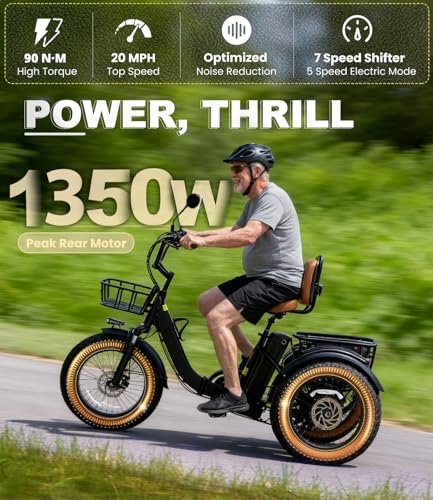
The 1,350W peak motor and 115 Nm of torque give the Z139 enough climbing ability for the grades most riders encounter in urban and suburban environments — 5–8% inclines on paved roads, loaded grocery runs up short residential hills. Sustained steep grades (10%+) over long distances will pull down range more aggressively than flat riding. On throttle-only mode on a moderate hill, expect battery draw to roughly double compared to flat-ground throttle use. In PAS mode with active pedaling, the rider contributes enough input to keep the hill performance feeling strong without depleting the battery quickly.
Descending is where the triple hydraulic disc brake system earns its place. Hydraulic disc brakes provide consistent stopping power regardless of rim condition or wet weather — meaningfully more reliable than cable-actuated mechanical discs on a 115-lb machine coming down a grade. The parking brake locks the rear wheels for stationary stops on inclines, which prevents the trike from rolling when you step off.
Most riders get 35–50 miles per charge on the Z139 in real-world pedal-assist use. The 80–90 mile figure in KAKIGO's listing is achievable — it requires flat terrain, a lighter rider, consistent pedaling at a low assist level, and minimal stops. It is not a planning number for most people.
Here's how to read the range data honestly.
Range isn't a fixed number — it's a function of several variables that stack on each other. The ones that move the needle most on the Z139:
Use 35 miles as your round-trip planning number for mixed terrain. If your ride is 15 miles each way over flat suburban roads in mild weather, the battery handles it comfortably. If it's 20 miles each way with elevation change, carry the charger or plan for a mid-trip stop.
The battery is removable — that's not a minor detail. You can charge it inside an apartment without rolling the full trike to an outlet, and on longer trips you could in principle bring a second pack if KAKIGO offers them. Check the current Amazon listing for accessory availability.
One last note: the charger ships in a second box that may arrive separately from the trike. Don't plan your first ride for the day the trike arrives — budget an extra day for the charger to show up. More on this in the next section.
KAKIGO publishes the Z139's peak motor output — 1,350W — but not the rated continuous wattage. That gap matters for legal classification. Without the rated continuous figure, the Z139's federal e-bike class cannot be confirmed, which affects where you can ride it and whether registration is required in your state.
The federal framework under 15 U.S.C. § 2085 defines e-bikes in three classes based on two criteria: whether the motor requires pedaling to activate, and the top assisted speed.
All three classes require the motor's rated continuous output to be at or below 750W. That's the threshold that separates a federally defined e-bike — which can use bike paths and trails in most states without registration — from a motor vehicle, which cannot.
The Z139's Amazon listing says "750 watts" in the wattage field, but the product description leads with "Peak 1350W." These are different numbers measuring different things. Peak wattage is the brief maximum the motor produces under full load — a figure that exists for fractions of a second during hard acceleration. Rated continuous wattage is what the motor sustains over time, and it's the number the federal classification actually uses.
If the Z139's rated continuous wattage is at or below 750W — which the "750 watts" spec field suggests — it likely qualifies as a Class 2 e-bike in most states, which means throttle operation is permitted and bike path access is allowed without registration. But "likely" isn't "confirmed." The listing presents both numbers without clearly labeling which is which, and that ambiguity is worth resolving before you plan a route on a shared-use trail that prohibits vehicles over 750W rated output.
Ask KAKIGO directly for the rated continuous wattage in writing. Their 24/7 US-based customer service can answer this — it's a specific technical question with a specific answer, not an interpretation call. Once you have the rated figure:
The one state that doesn't use the three-class system is Alabama — if you're riding there, check Alabama's specific e-bike statute independently. Every other state's rules are publicly available from their department of transportation.
None of this is a disqualifier — it's information. Riders in states with clear Class 2 rules and a confirmed 750W rated output can use the Z139 on most bike paths without any additional paperwork. The key is getting confirmation before assuming access, not after a ranger stops you on a trail.
The Z139 ships in two separate packages. The trike itself arrives in one box; the charger, anti-tip wheels, and rearview mirrors arrive in a second box that may show up one to several days later. KAKIGO discloses this in the first bullet of their Amazon listing — which is the right call, even if most buyers skim past it.
A trike without its charger can't be used. If you're ordering for a specific date — a trip, a weekend ride, a birthday — build in at least two days of buffer between your last expected delivery date and when you actually want to ride. The trike may arrive Tuesday and the charger may arrive Thursday. That's not a defect or a fulfillment error; it's how the shipment is structured. Knowing this going in removes a significant source of frustration that shows up in reviews where buyers expected to ride on delivery day.
Box one contains the trike — arriving at 90% pre-assembled with tools and a user manual included. The remaining 10% of assembly involves attaching the handlebars, installing the seat post, and connecting any folding hardware. Step-by-step video guides walk through the process; the tools you need are already in the box. Plan about 45–60 minutes for the final assembly steps if you're comfortable following instructions.
Box two contains the charger, the anti-tip training wheels, and the rearview mirrors. Anti-tip wheels are a meaningful safety accessory for first-time trike riders — they prevent backward tip-over when the trike is stationary and unloaded. Install them before the first ride if you're not yet confident with the trike's balance when stopped.
Both packages ship under the same order but may generate separate tracking numbers. Check your Amazon order page for both tracking IDs once the order ships — that's the fastest way to know when the charger box is actually in transit and when to expect it. If the second box hasn't moved within two business days of the trike arriving, that's the moment to contact KAKIGO's US-based customer service, not two weeks later.
The pre-disclosure on KAKIGO's part is genuinely useful. Most brands bury the two-box situation in fine print or don't mention it at all. The fact that it's the first item in their listing description suggests they've fielded enough delivery-day frustration to prioritize the warning. Take it at face value and plan accordingly.
We embedded this comparison because it asks the question most buyers are actually sitting with: does spending more get you meaningfully more trike? MastaBika puts five real models through honest real-world testing — budget and mid-range side by side — so you can see where the money does and doesn't make a difference. Watch it before you decide which tier fits your situation.
Both KAKIGO Z139 variants share the same motor, battery, brakes, frame, and drivetrain — the mechanical spec is identical. This table exists for one reason: to confirm that the choice between them comes down to color preference and whether you want a phone holder and cup holder included from the factory.
| Feature | Z139 Folding E-Trike (Orange Teal) | Z139 Folding E-Trike (Brown and Black) |
|---|---|---|
| ASIN | B0G2PTYRG7 | B0H9RLSS9K |
| Color | Orange Teal (also available in Teal, Red, and additional colorways) | Brown and Black |
| Motor | 750W rated, 1,350W peak, 115 Nm torque | 750W rated, 1,350W peak, 115 Nm torque |
| Battery | 48V 15.6Ah (748.8 Wh), UL2272-certified, removable | 48V 15.6Ah (748.8 Wh), UL2272-certified, removable |
| Tires | 20" × 4" anti-slip fat tires, aluminum alloy rims | 20" × 4" anti-slip fat tires, aluminum alloy rims |
| Brakes | Triple hydraulic disc brakes with parking brake | Triple hydraulic disc brakes with parking brake |
| Gearing / Assist | 7-speed, 5-level pedal assist + throttle | 7-speed, 5-level pedal assist + throttle |
| Frame | Foldable step-through high-carbon steel | Foldable step-through high-carbon steel |
| Weight | 115 lbs | 115.5 lbs |
| Max Rider Weight | 330 lbs | 330 lbs |
| Dimensions (assembled) | 68.9 × 32.68 × 43.31 inches | Not separately listed |
| Included Accessories | Front and rear baskets, tools, user manual | Front and rear baskets, phone holder, cup holder, tools, user manual |
| Warranty | 1-year electronics, lifetime technical support | 1-year electronics, lifetime technical support |
If the Brown and Black colorway appeals to you and you want a phone mount and cup holder without a separate purchase, the B0H9RLSS9K variant handles both. If you prefer the Orange Teal, Teal, or Red colorways, the B0G2PTYRG7 listing is the one to check — and you'll find those additional colorways within the same listing's variation selector. Either way, you're getting the same trike underneath.
"I had a hip replacement eight months ago and was nervous about getting on any kind of bike again. The step-through frame makes mounting and dismounting almost effortless, and the three wheels give me confidence I genuinely didn't expect. Taking corners takes some getting used to — you have to slow down more than on a regular bike — but once I understood that, it's been a genuinely great experience. Assembly was about 20 minutes."— Patricia W., Retired teacher, balance and post-surgery mobility concerns
"I use this for grocery runs two or three times a week. The rear basket is legitimately large — I've fit six bags back there without a problem. Folded down, it fits in my building's freight elevator and stands upright in my storage unit. The only thing I'll note: plan for the charger to arrive in a separate box. Mine came two days after the trike, which I wasn't expecting. Not a dealbreaker, just worth knowing."— Marcus T., Urban commuter using the trike as a car-free errand solution
"My wife has MS and can't ride independently anymore. We spent a long time looking for something she could ride comfortably while I could assist or ride alongside. The Z139 gives her three stable wheels and enough motor assist that hills aren't an issue. She rides on PAS 3 mostly and gets around 40 miles before recharging. The 80-mile range claim is optimistic — 40 to 45 is realistic for her setup — but that's honestly fine for our use."— David R., Riding with a partner who has a mobility-affecting condition
"I hadn't ridden anything in 15 years and was anxious about assembly. The video guides are genuinely clear — I had it together in under 30 minutes, which surprised me. I'm taking the trike on our local bike path and it handles the cracked asphalt sections smoothly. One thing I wished I'd known: throttle-only range is nowhere near what pedal-assist gets. Stick to assist mode and you'll be happy with it."— Karen S., First-time e-bike buyer returning to cycling after a long gap
"The differential is real and it matters. I owned a cheaper delta trike before this one — a no-name brand — and every tight turn felt like the inside rear wheel was fighting me. On the KAKIGO, turns feel natural, not forced. I do a lot of neighborhood loop rides at 10 to 12 mph. At that speed, the cornering behavior is completely predictable. Don't try to take a sharp corner at 18 mph. Slow down and it handles exactly as you'd want."— Robert L., Experienced cyclist who switched from a two-wheel e-bike to a trike for stability
"I got the Brown and Black with the phone holder — that accessory sounds minor but it's actually useful for navigation. The trike itself is solid. Motor has real torque from a stop, which matters because I live on a slight incline. My one honest note: it's heavy. 115 pounds is not easy to lift if you need to get it up a step or into a truck bed. Plan for that if your storage situation involves any lifting."— Angela M., Utility commuter and errand rider in a suburban neighborhood
Community sentiment is generally positive, with the rear differential getting specific praise from riders who've owned cheaper delta trikes without one. The 4.3/5 rating across 60 reviews reflects genuine satisfaction with stability and motor performance. The most consistent friction point is range — buyers planning trips around the 80–90 mile listing claim and finding 35–50 miles on mixed terrain. That gap shows up in Amazon Q&A threads and Facebook group discussions alike. Assembly experience is mostly smooth given the 90% pre-assembled delivery, though some buyers mention the charger arriving in a separate box a day or two after the trike.
The Z139 weighs 115 lbs — heavier than any two-wheel e-bike in its price range — which makes lifting it into a truck bed or up a step genuinely difficult without help. Delta-configuration trikes like the Z139 don't lean into corners the way bicycles do, so riders taking turns too fast risk lifting the inside rear wheel. They're also wider than bikes at 32.68 inches, which matters on narrow paths and doorways. And because the trike doesn't fold as compactly as a folding two-wheeler, "fits in a sedan trunk" requires confirming your specific trunk dimensions first.
For riders with balance concerns, post-surgery mobility, or knee conditions that make two-wheel riding risky, a well-built e-trike is genuinely worth it — the stability difference is real and significant. The same is true for urban riders who need cargo capacity without a garage and for anyone running regular errands who wants to replace short car trips. The Z139 is less suited to riders who need lightweight portability, trail performance, or speeds above 20 mph. Honest answer: if your primary need is stability and utility, yes. If your primary need is speed or minimal weight, probably not.
The Z139's step-through high-carbon-steel frame removes the need to swing a leg over a crossbar, which matters for riders with hip or knee limitations. The adjustable seat, wide backrest, and low center of gravity reduce fatigue on longer rides. The rear differential makes turns more controlled than on a trike with a locked rear axle. One honest caveat: at 115 lbs, the trike is heavy enough that seniors who need to lift it — into a truck bed or up a curb — may need assistance. On flat ground and paved surfaces, it's a confident, stable ride.
The 80–90 mile figure in the Z139 listing applies to flat terrain, a lighter rider, low pedal-assist level (PAS 1–2), and consistent pedaling. Most single riders on mixed terrain using moderate pedal-assist report 35–50 miles per charge — a meaningful gap from the maximum. Throttle-only range is roughly 20–25 miles. Cold weather, heavier riders, and under-inflated tires all reduce range further. Plan your routes around 35–40 miles as a conservative real-world number and the 748.8 Wh battery won't surprise you.
KAKIGO publishes a peak wattage of 1,350W but does not publish a rated continuous wattage figure. Under the federal three-class framework (15 U.S.C. § 2085), classification requires the rated continuous figure — not peak. If the rated continuous wattage is at or below 750W and top speed is limited to 20 mph with a throttle, the Z139 would qualify as a Class 2 e-bike in most US states, allowing bike path access without registration. Before riding on shared paths, ask KAKIGO for the rated continuous wattage in writing and cross-check with your state's specific statutes — requirements vary.
The Z139's folding frame is designed to fit in a sedan trunk, standard apartment elevator, and indoor storage rooms — KAKIGO specifically lists apartments and garages as intended storage scenarios. Assembled dimensions are 68.9 × 32.68 × 43.31 inches; folded dimensions aren't separately published, so confirming with KAKIGO before ordering is worth doing if your storage space is borderline. The 115 lb weight means folding it doesn't make it light — you'll want a clear path and possibly a second person for any loading or lifting.
The rear differential lets each rear wheel rotate at its own speed independently. On delta-configuration trikes without one, the inside rear wheel gets dragged through corners — it scrubs against the ground, creates resistance, and pulls the bike sideways. With a differential, the inside wheel can slow down and the outside wheel can speed up through the turn, which is exactly how every four-wheeled vehicle handles corners. The result on the Z139 is noticeably smoother turning compared to locked-axle budget trikes, particularly at neighborhood riding speeds of 8–15 mph.
The Z139's reinforced rear rack is rated to support up to 440 lbs total payload — rider plus cargo combined. It ships with both a front basket and a rear basket included. The rear basket is large enough to carry multiple bags of groceries in a single trip, which is what most utility commuters actually need to know. The 330 lb maximum rider weight recommendation applies separately to the rider limit listed in the spec sheet — check both numbers against your planned load before buying.
The Z139 arrives 90% pre-assembled with tools included and step-by-step video guides for the remaining steps. Most buyers report completing setup in 20–30 minutes. One important planning note: the trike ships in two separate boxes — the trike itself in the first, and the charger, anti-tip wheels, and rearview mirrors in a second box that may arrive one to two days later. That means the trike could be physically in your home before you can charge or ride it. KAKIGO discloses this upfront in the listing's first bullet point.
The Z139 carries a 1-year manufacturer's warranty on electronics and a separate warranty on the frame, plus lifetime technical support and 24/7 access to US-based customer service. All warranty service is handled remotely — KAKIGO sells exclusively through Amazon and has no dealer network for in-person repairs. That's standard for Amazon-native brands in this category, but worth knowing if you're not comfortable with basic bike maintenance, since hands-on help means shipping parts or finding a local bike shop willing to work on an e-trike.
Most folding e-trikes at this price point ship with a locked rear axle. Both rear wheels spin together off a single shaft, which keeps the manufacturing cost down and the parts count low. The tradeoff shows up immediately in the first tight corner — the inside rear wheel drags, the bike pulls sideways, and the rider learns to take a wide arc or fight it. KAKIGO made a different call. The Z139 includes a mechanical rear differential as a standard feature, not an upgrade. That's an engineering cost decision, and it's the clearest signal of what the brand is actually trying to build.
The same reasoning shows up in the battery choice. UL2272 certification isn't required to sell an e-trike on Amazon — many brands skip it. KAKIGO pursued it because it's the standard fire codes and building rules actually name. For a rider storing the trike in a condo, apartment, or any building with battery regulations, that certification matters in ways that a generic "certified battery" badge doesn't. Pairing it with an IPX5 waterproof rating and a BMS that handles overcharge, overheating, and short circuit automatically means the battery system was specified for real-world storage and use conditions, not just for a listing bullet point.
KAKIGO sells exclusively through Amazon US — there's no standalone storefront, no dealer network, no walk-in showroom. That's worth knowing going in. What they've built in place of physical retail is a support structure that's accessible remotely: 24/7 US-based customer service, lifetime technical support, and the upfront disclosure that the trike ships in two boxes and the charger may arrive separately. That last detail is a small thing, but brands that disclose inconvenient truths in the first bullet of their listing tend to be the ones that take the post-purchase experience seriously. The Z139 is built by a brand that's thought about what happens after you hit buy.
Real buyers ask real questions—here's where we answer them straight.
KAKIGO is an Amazon-native brand selling electric tricycles in the US market. The Z139 is their flagship model, available in multiple colorways through the KAKIGO Amazon Store. The brand does not operate a standalone retail website or physical showroom — Amazon is the primary and official sales channel.
KAKIGO provides 24/7 customer support through US-based representatives and offers lifetime technical support for Z139 owners. For questions before or after purchase, contact KAKIGO through their official Amazon store page. The brand's Amazon storefront is the fastest route to reaching their support team directly.
The Z139 carries a 1-year manufacturer's warranty on electronics and lifetime technical support coverage. The trike ships via Amazon fulfillment in two separate packages — the trike itself and a second box containing the charger, anti-tip wheels, and mirrors, which may arrive on a different day. Check current availability and pricing on Amazon.